Maraming Lamok sa Dilim: Revivifying the Mosquito Press

I have always wondered why there’s always a swarm of mosquitoes flying around, irritably buzzing, on top of my head, most especially after the sun sets, when it’s dark. How they’re more agile during the night when you’re soundly asleep, sneaking in a bite– always craving the taste of blood– leaving a mark. A harsh red spot. Itching. Sore. And it won’t go away easily.
It was also night on September 21, 1972 when late dictator Ferdinand Marcos Sr. announced Proclamation No. 1081, imposing Martial Law. For some, it was another brisk night– for many, it was hell. A wind that left all doors shut, leaving no space, not even an inch, for mosquitoes to enter.
Within the first week of the declaration, Marcos Sr. issued Letter of Instruction No. 1, authorizing the military to take over the assets of major media outlets, including the ABS-CBN network, Channel 5, and various radio stations across the country.
Among the journalists who were arrested on the first week of Martial Law were Teodoro Locsin, Sr., publisher of the Philippines Free Press, Manila Times publisher, Chino Roces, and several well-known journalists including Amando Doronila, Luis Beltran, Maximo Soliven, Juan Mercado, and Luis Mauricio. Reporters, editors and columnists from the Manila Times, the Daily Mirror, the Philippines Herald, the Manila Chronicle, the Philippine News Service, the Evening News and Taliba were included in the “National List of Targets” by the Armed Forces of the Philippines. Approximately 8,000 journalists were left jobless. By mid-1985, US-based media watchdog group Committee to Protect Journalists (CPJ) tallied a total of 12 journalists killed since 1984. The National Press Club, on the other hand, says that 19 were killed and one has been missing since 1976.
Meanwhile, The Times Journal,Times Mirror, and the People’s Journal, owned by Imelda’s brother Benjamin Romualdez, Bulletin Today, Tempo, Balita, Panorama, Daily Express, Weekend Magazine, TV channels 9 and 13, all of which are owned by Marcos’ cronies Hanz Menzi and Roberto Benedicto, served as Marcos’ own mouthpiece and was called the “crony press”, spreading propaganda and falsehoods, creating an illusion of prosperity based on infrastructure and temporary projects, all under the pretense of free speech.
What was once deemed as the “freest” press in Asia, is now under the chokehold of an iron fist– swatting mosquitoes just as before they turn off the lights, before fully succumbing to darkness.
If we trace back its history, alternative media was already around since the propaganda and revolutionary period of the country. But it was around the Martial Law period where it gained traction and was revived, and ultimately the term “mosquito press” was coined.
Like mosquitoes in the dark, as the light flickers through diminutive holes and scratches on the wall, they thrive– looking for hosts they can feed on. They are stronger– collectively getting bigger, just when the enemies thought they would disappear.
Prominent Martial Law figure, writer, and revolutionary Jose Maria Sison once said, “crisis generates resistance”, and for the case of the mosquito press, it was the repressive, despotic, and brutal regime, where the pen was held, making it a weapon.
Jose Burgos Jr. started WE Forum in 1977 and Malaya in 1981, other aboveground publications include Signs of the Times by the Catholic Bishops Conference of the Philippines (CBCP) and Mr. & Ms. Magazine pioneered by Eugenia Apostol. Underground publications such as Ang Bayan, Liberation, Balita ng Malayang Pilipinas, Taliba ng Bayan, and literary magazine Ulos were also publishing critical stories and had counterparts in different provinces.
Student publications and journalists under the College Editors Guild of the Philippines (CEGP) also saw how atrocious the things that were happening in the country were and decided to publish stories beyond their institutions, and some who decided to sacrifice their lives to serve the masses through the highest form of struggle.
Antonio Tagamolila, a native of Iloilo City, was the editor of the Philippine Collegian in 1971 and the president of CEGP in 1960. It was in 1972 when Martial Law was declared that Tony decided to leave his family in Panay and take the revolutionary path, trading his pen for a gun. He died in an armed encounter with state forces in the hills of Aklan in 1974.
Liliosa Hilao was the associate editor of Ang Hasik, the official student publication of Pamantasan ng Lungsod ng Manila, when she wrote an essay titled, “Democracy is Dead in the Philippines under Martial Law.”
She was arrested in April 1973 and was brought to Camp Crame, headquarters of the Philippine Constabulary (now the Philippine National Police). Her body was found the following day, already dead, bearing marks of torture and sexual abuse. Liliosa was the first political prisoner who died in detention during Martial Law.
Abraham “Ditto” Sarmiento Jr., then editor in chief of the Philippine Collegian, official student publication of the University of the Philippines- Diliman, published a statement signed by 500 opposition leaders assessing the three years of Martial Law, and an editorial entitled “Kung hindi ngayon, kailan pa?.” Sarmiento was interrogated and imprisoned for three months until his health deteriorated and died at the young age of 27.
The mosquito press exposed myriads of truths, it opened a line, a power-hungry dictator tried to shut down. Tantamount to mosquitoes in the dark, they swarm to sting the hands that tried to bury them alive– the hands that bore the blood of thousands of Filipinos.
Many people believe that a mosquito dies instantly after it bites you. I am no genius but I read somewhere that this is entirely fiction. Truth is, they live up to a maximum of 100 days, if it bites enough people and manages not to get killed, it can live approximately one to three months. Their lives are not halted by a singular bite– similar to a movement, to the people's struggle. It goes on. It stays alive for as long as it needs to be.
Like mosquitoes in the dark, those who came before us, crept through the cracks, grappled the chains that bound them, using their pens as their weapons, they sought to be free.
Parallel to today, the Mosquito press and the alternative media is stronger than ever.
Now, there are approximately 35 alternative media outfits, brought together by Altermidya People’s Network and existing media outfits and institutions, operating in different regions and provinces all over the country, all fighting for one ultimate goal: TELL, WRITE, AND REPORT THE STORIES OF THE MASSES– the truth.
Relentlessly pushing boundaries, resisting attacks, and propagating and advancing the line the masses have long struggled through history until today.
Mosquitoes lay hundreds of eggs in their lifespan. It regenerates and restores its history, its timeline, the testament of its struggle.
Thus, a new generation of mosquitoes will be born, swarming over the flickering fluorescent light of a dimly lit room, ready to strike back, to bite, to feast on the blood of the beast who will, just as then, turn the lights off.
___
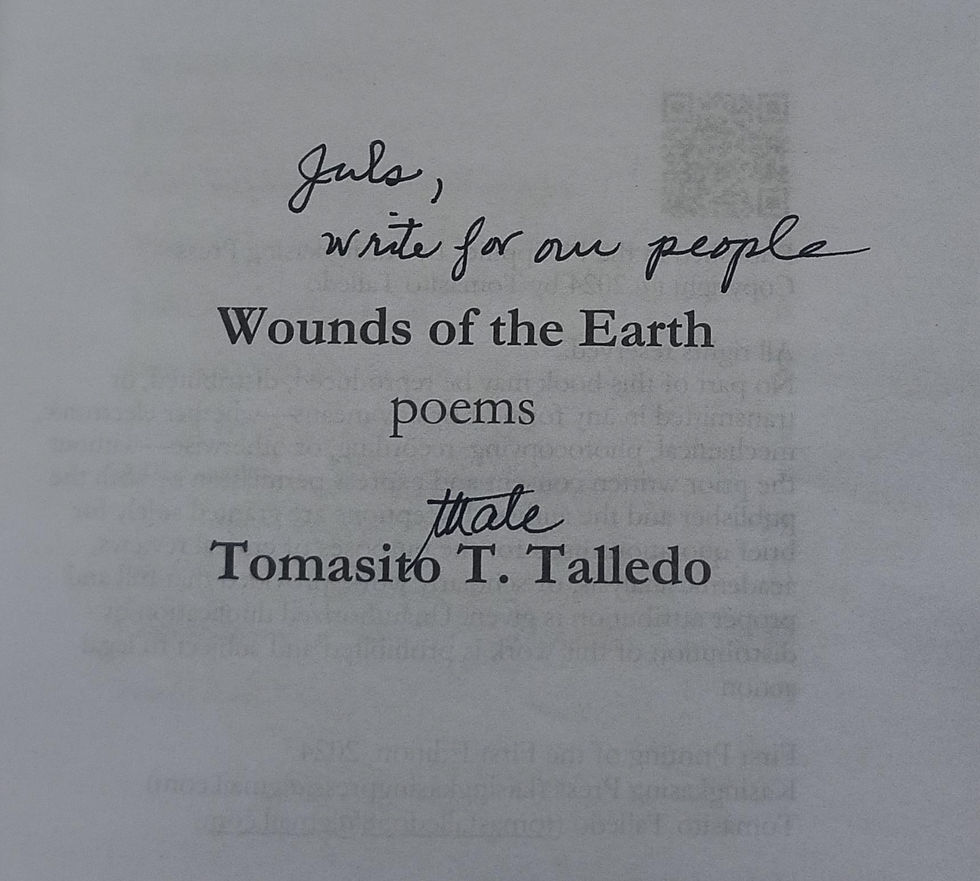
Clean(er) and the unedited version of a column i wrote for my Network's anniversary and my assignment for a comrade (he told me to write a feature article about martial law). This column is published in Kodao.org (edited).
J. Judilla, September 2024
Ref:
Comments